
What happens when three owners, with a combined 60+ years in the industry start talking about the lessons they’ve learned?
The pizza business isn’t easy. It takes a certain personality (and skillset) to last in this industry. The things you’ll see and experience. The ups and downs. The financial booms and margin squeezes.
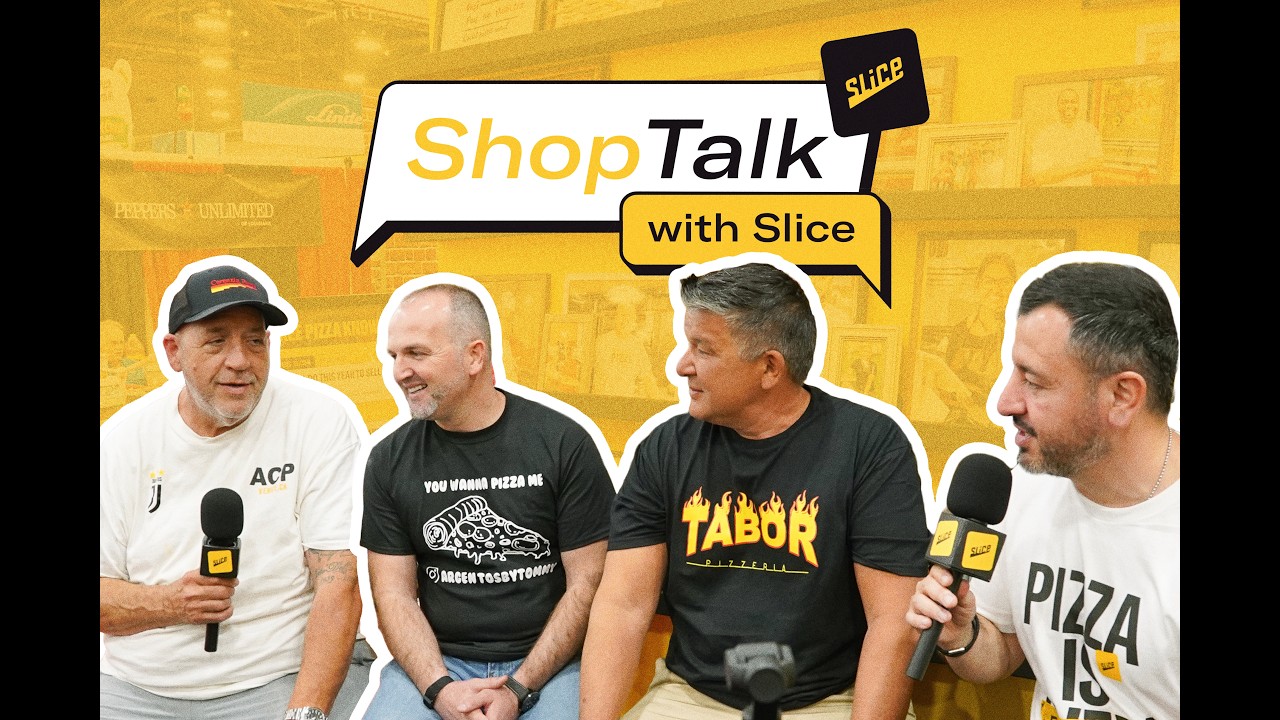
Ilir Sela, Founder and CEO of Slice sat down with three industry veterans, Tomor Turkeshi (Argento’s by Tommy), Kemal Andican (Tabor Pizzeria), Vito DeCandia (Angel City Pizza), to chat through the trials and tribulations they’ve seen in their extensive time in the industry. From coast to coast, these three have seen their fair share, and they did not hold back when we ask them for their opinions.
These are the 17 survival truths from pizzeria owners who have lasted, and their advice for how to still be open in 10 years.
View the full Shop Talk episode here 👇
17 survival truths from pizzeria owners
01 — HARD TRUTH
The margins your dad made don’t exist anymore.
In the 70s and 80s, a single location could make an owner genuinely wealthy. That math is gone. Utilities, insurance, wages, supplies — everything has gone up while the perceived value of a slice stayed stuck. The shops that survive accept this reality and build around it instead of hoping it changes back.
The days when guys like my dad were just banking cash like they had a machine — those days are gone. You have to be more innovative in how you make money now.
02 — WARNING
Third-party apps aren’t just taking a cut. They’re triple-dipping.
They charge the customer a delivery fee. They charge you a commission. They take a cut from the driver. Then they report $10–20 in profit per order. That’s more than you’re making. And the service is often terrible. Understanding this isn’t pessimism, it’s math you need to do before you sign anything.
They’re not single dipping. They’re not even double dipping. They’re triple dipping — charging the customer, charging you, and banging the drivers too. They wind up making more money than anyone.
03 — HARD TRUTH
That $50K signing bonus from a big platform? Do the math before you cash it.
If a platform offers $50,000 to sign exclusively, but takes 30% of your orders, calculate what 30% of your annual volume costs. In many cases you’ll hand back more than $55,000 in commissions and taxes in year one alone, and your customers paid 30% more for the privilege.
They offer you $50,000 to sign up. But then they take 30% out of all your orders. Do your math before you sign up. Always choose the right person to be next to you.
04 — SURVIVAL MOVE
Google is the mountain nobody can move. Build toward it.
Tomor tried every platform, ran a spreadsheet on their commissions, and migrated his orders to Slice. His bigger insight: a complete Google Business Profile with a direct ordering link is the single highest-leverage thing most independent operators aren’t doing. When someone searches for pizza nearby, who shows up matters more than what app they’re on.
Google is the big mountain that basically nobody can move. If you have Google and you put your website on it — use that one only. That’s what’s going to bring you all the orders.
05 — HARD TRUTH
Credit cards are now a cost of doing business. Build it into your pricing.
Cash used to be king. Now it’s a rounding error. Virtually every order is credit card, which means a processing fee on every transaction. That compounds over a year. Either you build it into your pricing or you absorb it. Most shops absorb it without realizing how much it costs annually.
Everybody uses credit cards now. Cash is like a squire — it’s not important anymore. There are just more things to combat of people trying to take your money.
06 — KEEP AN EYE ON
Raising your prices on delivery apps creates a problem you can’t win.
The math forces you to inflate app prices to account for the 30% commission. But when your prices go up on the app, order frequency drops — weekly customers start ordering every two weeks. So you’re making less per order AND losing volume. It’s a trap built into the platform model, and the only real exit is building your direct channel.
07 — SURVIVAL MOVE
Your box is a mobile billboard. Stop ordering the generic ones.
Kemal has been putting his name on boxes for 40 years. Every delivery to an office building, every pizza box sitting in a kitchen — that’s someone seeing Tabor Pizzeria.
Operators using generic boxes are paying almost the same price and getting zero marketing value. A branded box pays back every time someone sees it.
I like my box in the garbage — when you’re driving down the street and you see Tabor Pizza, that’s my box there. A lot of pizzerias don’t think of that.
08 — HARD TRUTH
Never cut ingredient quality to protect margins.
When costs go up, the temptation is to quietly swap to cheaper cheese, flour, tomatoes. Vito uses only the highest-quality ingredients. His answer isn’t to switch. It’s to price accordingly and make the case for quality. The moment you cut, you start losing the customers who came for the product.
I’m not going to jeopardize the integrity of my product. You want me to use cheap cheese and give you a $3 slice? Then you’ll go on Yelp and complain the cheese tasted like rubber.
09 — KEEP AN EYE ON
Consumers will pay for quality. They just need to be reminded why it’s worth it.
The guy in $1,000 worth of clothes asking if a $4.50 slice is pricey is operating on 1985 pizza economics in his head. Price of goods have gone up. The consumer’s mental model is broken, and operators who don’t correct it quietly subsidize that delusion at their own expense.
People are still under the misconception that it costs us $4.50 to make a pizza. It doesn’t. You want cheap cheese? Which one do you want — eat well, or complain on Yelp?
10 — SURVIVAL MOVE
Community isn’t a marketing strategy. It’s the business model.
All three owners built their shops around being the neighborhood place. Vito opened next to a high school on purpose. Kemal sponsors the soccer teams. Tomor raised his kids in his shop’s neighborhood. The regulars who’ve been coming for 20 years aren’t loyal to the pizza, they’re loyal to the place.
We wanted to give kids in our neighborhood what we had when we were kids — everyone had their local pizza shop. We wanted to give that back.
11 — SURVIVAL MOVE
Own your customer data. Every third-party order is a customer you don’t own.
When a customer orders through DoorDash or Grubhub, that platform owns the relationship. They have the email, the order history, the re-engagement capability. You get a ticket. The shops thriving in 10 years are the ones building a direct database of customers they can reach, reward, and bring back without paying a middleman every time.
12 — HARD TRUTH
One location used to be enough. For most shops today, it isn’t.
This is Veto’s hardest truth and he says it plainly: the profit margin at a single location is so compressed now that to pull what his dad pulled out of one shop in the 80s, you need three or four locations today. It’s not about ambition — it’s about the math of running a business when you’re getting 10% where you used to get 30%.
Instead of getting 30%, you’re getting 10%. To get the same thing you pulled out of one store in the 80s — you need four stores to do that now.
13 — KEEP AN EYE ON
The new generation orders online. The old guard orders in person. You need both.
Kemal has been watching this shift for 40 years. The new generation doesn’t want to talk on the phone. The older regulars want to come in, see a face, have a conversation. The shops that fail optimize for one group and alienate the other. The ones that last give everyone what they want.
There’s a new generation that doesn’t want to talk on the phone. But the old school people want to order at the counter. In the pizza business, you’ve got to roll with everybody.
14 — KEEP AN EYE ON
Robots aren’t the future problem. Your platform relationship is the current one.
Vito’s robot story is funny until you realize what it represents: a platform sending automated pickup vehicles to a pizzeria they have contractual leverage over, no regard for how an 18-inch cheese pie fits in a 12-inch robot. The relationship dynamic, where the platform has the customer data and you have the oven, is the problem to solve before robots even matter.
I told them: the next time you send me one of these robots, I’m going to kick it over. Next day — I get a robot.
15 — SURVIVAL MOVE
Passion is a business asset. When it goes, so does the quality.
“If there is no passion in the food business, there is no future.” That’s not sentiment, it’s operational truth. The shops where the owner stopped caring show it in the product within months. The ones still thriving at 40 years are the ones where the owner still cares.
If there is no passion in the food business, there is no future. You have to love doing it, and you have to stay updated with everything going on around you.
16 — HARD TRUTH
Staffing is the hardest problem in the business right now.
Vito doesn’t sugarcoat it: the next generation doesn’t want to work in pizza shops, and the ones who do want doctor’s wages. The operators managing it best are the ones who’ve built real culture — a team that feels ownership, shows up because they want to, and stays because the environment is worth staying in.
My hardest time as a shop owner is staffing. They don’t want to work. And if they do, they want to get paid like a doctor. It’s a different generation now.
17 — SURVIVAL MOVE
Stay consistent. The operators who last aren’t the ones who reinvent.
Kemal’s answer to “what does Tabor Pizza look like in 10 years?” was the most honest thing said: keep doing the same thing, just better. No pivots, no gimmicks. The buildings going up in his neighborhood are full of new customers who will want good pizza. The shop that’s been there, consistently, at the same quality… that’s the one they’ll find.
I’m not going to change my business. In 10 years, I’ll just improve. You stay strong, stay true to it, and keep doing what you’re doing.
The pizzeria survival kit 🛠️
With just 8 quick questions, you’ll get some personalized recommendations to last for years (decades) to come.