
The price of a large cheese pizza is up everywhere. New England? 31%. The Pacific region’s average has crossed $20. Even the lowest-increase region, Mountain, at 16%, still represents a meaningful jump over five years.
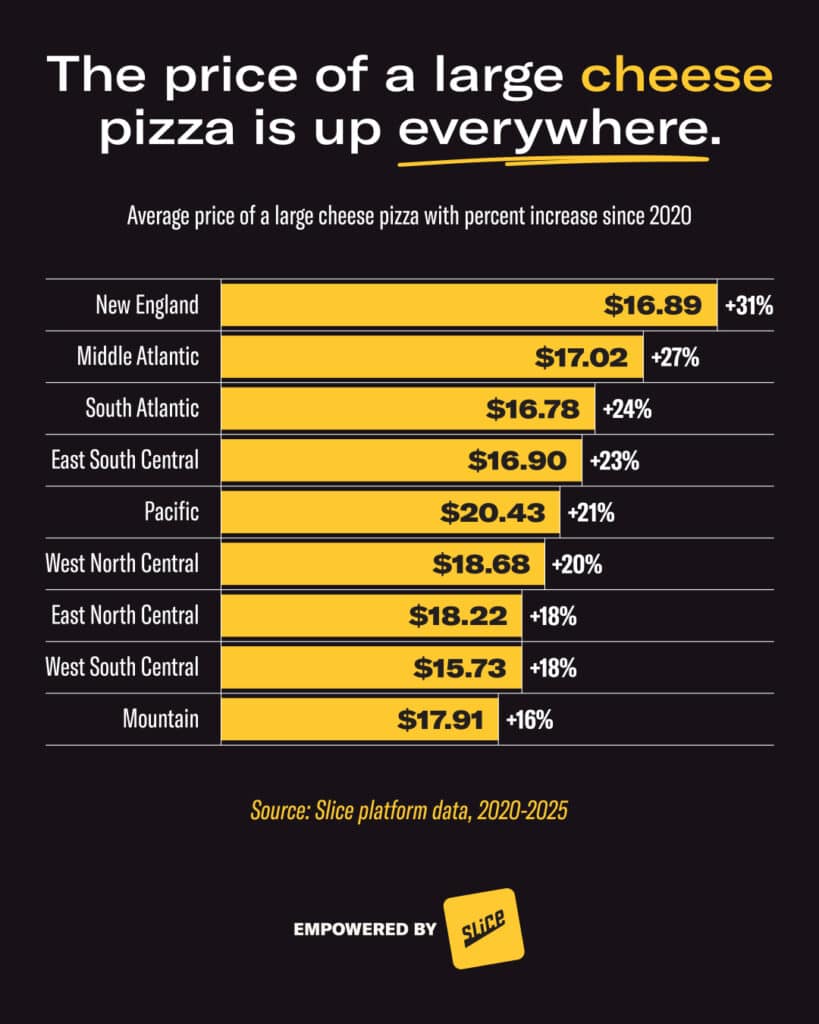
We pulled these numbers directly from Slice platform data across thousands of independent pizzerias between 2020 and 2025. They show what every shop owner already feels in their margins.
But what does this actually means for how you run your shop, how your customers behave, and what you should be doing about it right now?
Your customers noticed that the price went up.
When a large cheese pie costs $16–$20 depending on where you are, customers feel it. They’re not canceling pizza night, but they’re adjusting. Fewer toppings. Smaller pies. Skipping the extras. The ticket looks the same, but the behavior is different.
Data confirms this pattern. Customers aren’t abandoning their local shop. They’re trimming around the edges to keep pizza night affordable.
The demand is still there. Your customers want to keep ordering from you. They just need you to make it easy for them to do it in a way that fits their budget.
👀 ICYMI — Vito, from Angel City Pizza sat down with Slice recently to chat about consumer behavior, and how someone wearing $1000 fits will still complain about a slice costing $4.50. 👇
This is exactly why tools like Slice Rewards exist. A structured loyalty program gives customers a reason to keep ordering from your shop instead of switching to a chain with a coupon.
Cheese isn’t the real cost. It’s everything around it.
Cheese is the biggest single ingredient cost on a pizza. When cheese prices spike, your food cost jumps immediately. But these price increases aren’t just cheese. They reflect labor, rent, utilities, packaging, and delivery costs all compounding at once.
Labor alone is quietly eating margins at a lot of shops. If your staff is spending 80–100 hours a month just answering phones and managing orders manually, that’s payroll going toward tasks that don’t improve your food or your customer experience.
Phone orders are a perfect example. Every call takes 2–3 minutes of paid labor. Multiply that across a full day and you’re looking at thousands of dollars a year in hidden labor cost. This is money that could be recovered by shifting more orders to online channels where the customer does the work themselves.
When cheese goes up $0.50 a pound, you notice. When labor waste costs you $1,500 a month, you might not, because it doesn’t show up on a single invoice.
But it’s there.
Raising prices is fine (but it’s not a “strategy“)
Raising prices is reasonable. Data proves every region has done it. But raising prices alone doesn’t solve anything, it just buys time.
If your costs keep climbing and your only lever is the menu price, you eventually hit a ceiling where customers start looking elsewhere. The shops that stay ahead are the ones attacking the cost side and the revenue side at the same time.
If your costs keep climbing and your only lever is the menu price, you eventually hit a ceiling where customers start looking elsewhere.
On the cost side — Reduce labor inefficiency by moving orders online.
Slice’s commission-free online ordering means you’re not paying a third-party platform 15–30% per order to process what your website should handle. That margin stays with you.
On the revenue side — Build repeat business through loyalty, branding, and direct ordering channels
Keep your customer coming back to you, not to whoever has the best coupon this week.
Slice’s CEO Ilir Sela put it well during a CNN appearance: pizza isn’t going anywhere as a weekly habit. The question is whether independents or chains capture that demand. [Link: Slice on CNN: The Reality Facing Independent Pizzerias]
What the regional gaps actually tell you
- The Pacific region averages $20.43 for a large cheese.
- West South Central averages $15.73.
That’s nearly a $5 gap for the same product category.
Pricing power is deeply local. A shop in Portland, Oregon can’t price the same as a shop in Houston, Texas. And they shouldn’t try to. Your pricing needs to reflect your local cost structure, your local competition, and your local customer expectations.
This is where data-driven decision making matters.
If you’re in a region where prices have jumped 25–30%, your customers have already felt that and adjusted. That doesn’t mean you can’t raise prices again. It means every dollar counts more, and the way you present value to your customer matters more than it did in 2020.
What to do right now
Get your ordering online and commission-free.
- Every order that comes through a third-party app at 20–30% commission is amplifying the cost problem you’re already dealing with. Slice’s online ordering keeps that margin in your pocket.
Lock in repeat customers with Slice Rewards.
- When prices are up, loyalty is everything. Give your customers a structured reason to keep coming back instead of price-shopping between you and the chain down the street.
Cut hidden labor costs.
- Shift phone orders to online. Free up your staff to make food instead of answering calls. The savings are real and they compound every month.
Use your own data.
- Slice’s Owner’s Portal gives you visibility into order trends, customer behavior, and revenue patterns. Use it. Pricing decisions based on your actual data are better than gut feelings in a rising-cost environment.
Don’t panic.
- Pizza night is an institution. Demand isn’t disappearing. It’s adapting. The independents who adapt with it are the ones who come out ahead.
The bottom line
The price of a large cheese pizza is up 16–31% depending on where you are. That’s not going to reverse. The owners who treat rising costs as a signal to get smarter, not just more expensive, are the ones building shops that last.
Watch: Will your pizzeria exist in 2036? 👇

Content referenced: